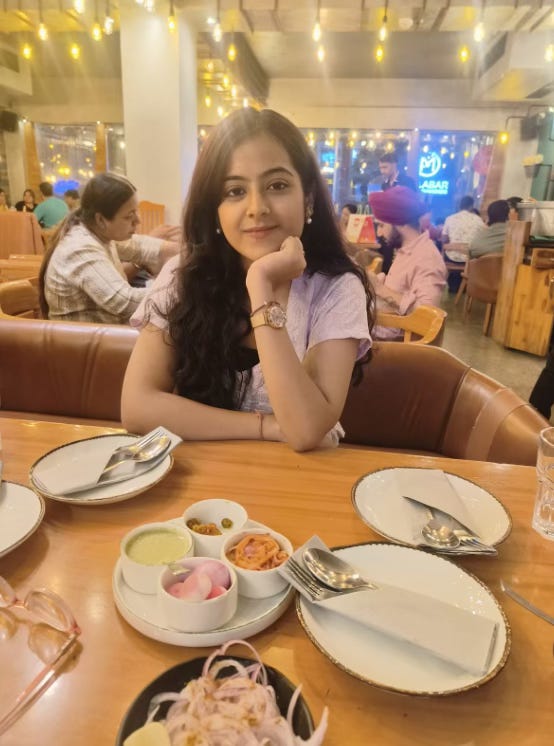
The Pehli Peedi Fellowship presents the first in a series of stories highlighting the experiences of first-generation students across India.
Tanya Pasricha, a biotechnology graduate from Sharda University, grew up in a household where education was treasured but rarely attainable. Her grandparents, once prosperous in Peshawar and Karachi, were displaced during Partition, losing everything. The legacy of that upheaval shaped her childhood—a quiet determination to create the stability her family had been denied.
Her early schooling offered little in the way of resources, but it ignited a curiosity that refused to fade. College opened the door to the scientific world she had long imagined, and with it came the realization that her ambitions stretched beyond the laboratory. She discovered a love for leading projects, building connections, and shaping ideas into tangible outcomes.
Today, Tanya is preparing to pivot from science to an MBA in Marketing. For her, the journey is not just about professional growth—it is about reclaiming a sense of security that was once lost and building a life grounded in independence, purpose, and dignity.
Read her full story below. Profile by Riya.
Riya: Tanya, your family history is one of resilience across generations. Can you share a little about it?
Tanya: My family’s story begins with loss. Both sides were uprooted during the Partition of India and Pakistan. They didn’t come from poverty; they were affluent—my father’s family from Peshawar and my mother’s from Karachi. But overnight, they lost everything—homes, land, wealth. They arrived in India as refugees with nothing, forced to start over in cramped government housing, sometimes even slums.
My paternal grandfather was the youngest of thirteen children, and they lived in conditions most would consider inhumane. My dad struck out on his own at nineteen, driving for a politician in Lucknow before building a small business in Delhi. My mother’s father, after losing his factory job to a fire, ended up selling tea on the roadside until an accident left him unable to work at all.
Riya: What was the level of education of your parents?
Tanya: Neither of my parents could go to college. They both finished class 12, but that was it. They dreamed of more, but financial hardship and family duties forced them to start working right away. So, they poured that unfulfilled dream into me and my sister, ensuring we had every opportunity they never did.
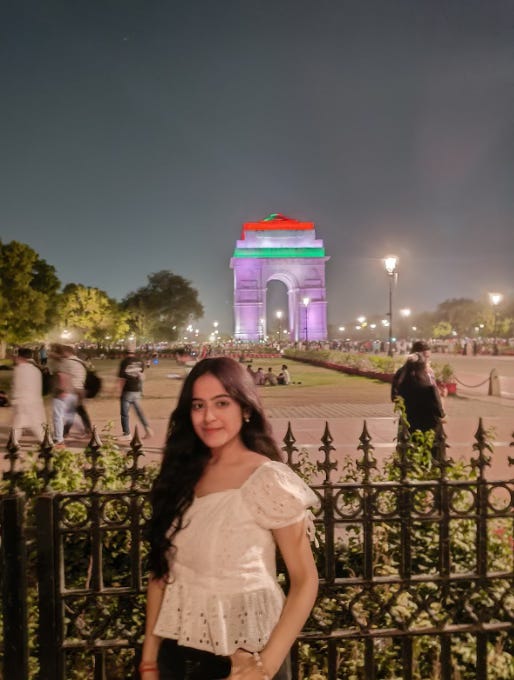
Riya: How did growing up in this legacy shape you?
Tanya: It gave me a deep appreciation for stability. When you come from a family that has lost everything, success isn’t about getting rich—it’s about building a peaceful life where you’re not constantly fighting for survival. I want to build a future where I and the people I love feel secure.
Riya: You’re the first in your family to pursue biotechnology. What was your school experience like?
Tanya: My first school, a private one I attended until class 10, was a school in name only. It was worse than most government schools—we had no library, no science lab, and sometimes, entire subjects had no teacher at all. For classes 11 and 12, I switched to a better private school, but just as I was getting excited about real, hands-on science, the pandemic hit. Everything went online, and my dream of working in a lab was put on hold again.
Riya: So, what was it like to finally get to college?
Tanya: Walking onto the Sharda University campus was like stepping into another world. After years of makeshift classes, here were actual laboratories, real experiments, a world of research I had only read about. The commute was brutal—63 km each way. I’d be the first on campus for my 8 a.m. class and often the last to leave, getting home around 9 p.m. I was exhausted, but I was happy. For the first time, I felt like I was exactly where I was supposed to be. My love for research fueled everything.
Riya: Who has supported your education the most?
Tanya: My sister, without a doubt. She works in Canada and has financed most of my education, especially after my father’s health declined. She’s my hero. For me, she is living proof that the women in our family can break barriers and reach incredible heights.
Riya: As a woman in STEM, what challenges have you faced?
Tanya: Being one of the few women in my program was tough. There was one professor who consistently made sexist, inappropriate comments. One day in class, he threatened to slap me and then tried to pass it off as a “joke.” I was the only one who stood up to him. No one else said a word. In that moment, I felt completely alone, but looking back, it’s one of my proudest moments. I refused to be silenced.
Riya: You’ve spoken about wanting change in India’s education system. What would that be?
Tanya: Our system forces life-altering career decisions on teenagers. At 16, you’re expected to pick a single path, which is far too young. This is especially damaging for first-generation students who lack exposure. We need to build a system that encourages exploration—with internships, mentorships, and chances to experience different fields before making a choice that will define their lives.
Riya: What advice would you give to other first-generation college students?
Tanya: Don’t get trapped by the first path you choose. Be curious. Explore everything—internships, projects, part-time jobs—to discover what you truly love. Find mentors who can guide you, but also be a mentor to someone coming up behind you. Listen to others, but never let their opinions define your future. And most importantly, walk into every room believing you belong there—because you do.
Riya: What’s next for you?
Tanya: While I love research, my time in the lab taught me that my real passion is leading projects and connecting with people. That’s why I’m pivoting towards an MBA in Marketing. My ultimate goal hasn’t changed—it’s to build a life of stability, independence, and dignity, to finally achieve the peace my grandparents lost and could only dream of reclaiming.