
The Pehli Peedi Fellowship presents the first in a series of stories highlighting the experiences of first-generation students across India.
Dimple, a 20-year-old first-generation learner, dreams of becoming a journalist. At a time when journalism is often criticised for failing to amplify marginalised voices, she sees it as a powerful tool to represent unheard narratives. For Dimple, journalism is not merely a profession but a responsibility and a means of transformation.
As she puts it, “Journalism is history written against the clock. But some stories break away from time and linger forever in our memories.”
She hopes to build a career in this field and, in doing so, change the course of her own life.
Read her full story below. Profile by Prachi Chauhan
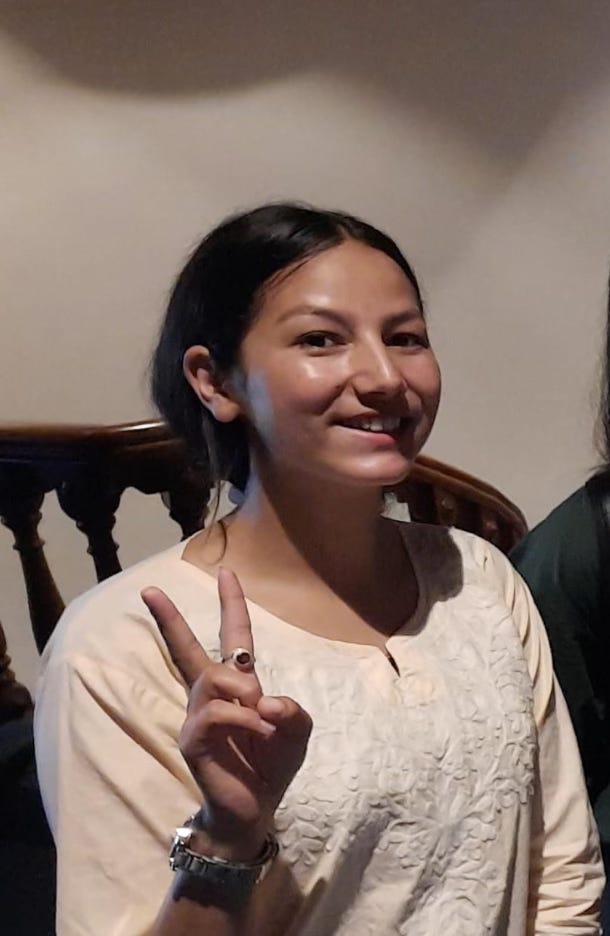
Prachi: Tell me about yourself.
Dimple: My name is Dimple, and I come from the village of Sainj in the Kullu district. My home is around 250 kilometres from Shimla, and like most families in my village, my family is engaged in apple farming. I am the youngest of four siblings. My elder sister was married at a young age, soon after completing her Class 12. I am the only member of my family who has gone to university; in fact, no one before me has attended college. Our family suffered a profound loss when my biological mother passed away in 2014. After her death, my father remarried to ensure that we continued to receive care and support.
Prachi: Tell me about your parents and their educational background.
Dimple: My father is a primary school teacher. He studied till Class 12 and later completed Junior Basic Training, which is a diploma-level teacher training course. My mother has studied till Class 4.
Prachi: Tell me about your school experience.
Dimple: I studied in government schools throughout. Till Class 5, I attended Government School Shafadi, which was close to my village. I completed my Class 12 from Government School Shansher. There were 30 students in my class. My school was one and a half hours away from my village, and we had to walk every day as there were no government or school buses available. Despite these challenges, my school experience was good.
Prachi: Were there any hurdles you had to overcome to go to college? Was the situation the same for everyone? How many students continued their education after Class 12?
Dimple: For college, I moved from my village to Kullu town. I took admission in Government Degree College, Kullu. I had to convince my father that I wanted access to libraries and coaching facilities, which were lacking in my village and still are. I rented a room in the town. There were many hurdles—I was hesitant, young, alone, and inexperienced. I shared a room with another girl, and the lack of personal space became a distraction that I struggled to manage. Often, I felt lost because there was no one from my family or peer group to guide me. Many of my classmates did go to college; some pursued professional courses in cities like Chandigarh and Delhi, while a few stayed back at home.
Despite all these challenges, I consider myself privileged. I had the privilege of choice. Many girls my age do not have that privilege—they lack autonomy. I acknowledge this and empathise deeply with other women.
Prachi: What were your expectations from the university? Were they met?
Dimple: In my Master’s class in the MAJMC programme, there is a lack of diversity, and this is true for the university as a whole. There are very few students from other states. I had expected better infrastructure and facilities, but the university falls short in some areas. The campus is small, and students are not very interactive or amiable. My expectations regarding campus life and the people here have not been fully met.
Prachi: What are your views on the changing nature of media and journalism?
Dimple: I aspire to be a journalist and wish to work in electronic media. I like being in front of the camera. I agree that today’s media—both print and broadcast—is often labelled as biased and has become highly commercialised. Facts are obscured, and truths are concealed, which has led to divisions within society. In contemporary discourse, the media has drifted away from its core function of providing facts and information. Consent is manufactured, and public trust in the media is steadily declining. However, I still believe that there are journalists and media houses that have upheld the integrity of journalism. I hope to work with independent media organisations.
Prachi: As you are currently pursuing your postgraduation, how do you cope with academic pressure or stress?
Dimple: I enjoy singing, and it helps me manage stress. Sometimes I cry, and that helps me release my worries. I also like journaling and writing a diary—it serves as a record of my day and helps me track my emotions.
Prachi: What kind of music do you enjoy?
Dimple: I enjoy folk songs, especially Kulluvi Pahari songs, ghazals, old Hindi songs, and qawwalis. Jagjit Singh and Chitra Singh are my favourite singers. Their song “Us Mod Se Shuru Karen” is my favourite, and I often listen to it while travelling from my classes back to my room.
Prachi: Who do you consider your mentors in life?
Dimple: My father and my entire family have always trusted me and encouraged me to study. My two brothers began working after completing school and have supported me throughout my journey.
Prachi: In your opinion, what can help first-generation learners succeed?
Dimple: I believe strong financial backing, whether from formal or informal sources, can greatly help first-generation learners. Additionally, educational institutions should form committees that provide 24×7 support and guidance specifically for first-generation students. Universities must foster supportive environments, integrate counselling services, and establish grievance redressal committees with student representation.
This is an ongoing series of profiles documenting the experiences of young people across India. Stay tuned for more stories from first-generation students across India. Follow us on social media for more updates.