
The Pehli Peedi Fellowship presents the first in a series of stories highlighting the experiences of first-generation students across India.
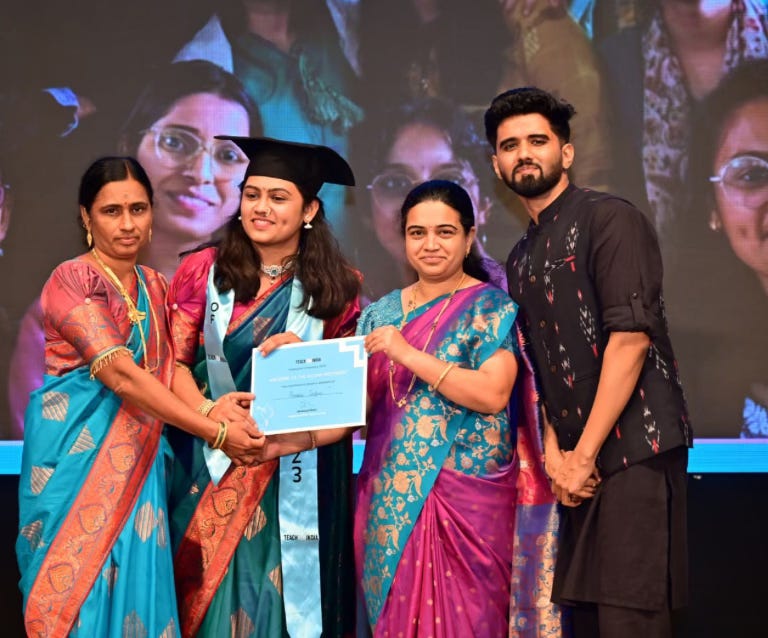
Raised in a small village in rural Aurangabad, Pratiksha Alka Bhagwan, 24, is a first-generation learner whose journey has been shaped by early responsibility, steady resilience, and a deep commitment to education as a means of change. After working in the social sector through the Teach for India Fellowship, she now serves as a Chief Minister’s Fellow in Satara while balancing a postgraduate certification course in public policy at Indian Institute of Technology Bombay. Her story is one of grit, loss, courage, and an unwavering belief that education can transform lives.
“If you are ready to fight, the world will support you.”
Read her full story below. Profile by Yatika Singh.
Yatika: Hi Pratiksha! Could you please introduce yourself?
Pratiksha: Hi, my name is Pratiksha Alka Bhagwan. I come from a small village named Baigaon, with a population of around 500 people, in a block in Aurangabad district, Maharashtra.
Y: What do your parents do? What are their educational backgrounds?
P: I am a first-generation learner. No one in my family has completed graduation or pursued higher education. I am the eldest child, and I have four younger siblings.
My mother’s name is Alka Bhagwan. My father’s name was Bhagwan Narayan. My mother studied until grade 4. My father did not continue schooling after failing grade 10. Two years ago, my father passed away, and my mother is now a single parent. She works on our farm, which is our only source of income. My siblings are currently pursuing their education.
Y: Was education easily accessible to you?
P: No, it was not as accessible as it is in urban areas. However, my parents—especially my mother—understood the importance of education. She had observed how her peers whose parents allowed them to study grew up to become independent, with one even working as a government supervisor. She survived domestic violence and overcame financial dependence, which made her realise how education could change one’s life.
Even after my father passed away, my mother took a strong stand for our education. In rural areas, when the head of the family dies, women are often pushed out of mainstream life. But she decided that her daughters would all be educated citizens.
Y: That is a very powerful decision. Were there any challenges to this?
P: Yes. Rural education comes with many basic challenges. If it rains, you may not be able to go to school. Roads are bad, and transport is unreliable. These issues can have a huge impact. Often, girls cannot afford private transport options.
Y: Where were you able to enroll to study?
P: I studied in a school outside my village because my father did not want us to attend the Zila Parishad school. He wanted us to study where the facilities were better. I studied there from grade 1 until graduation, as there was an attached college as well.
Y: How was your experience at school?
P: The quality of education was poor. During my graduation, a teacher once asked me the difference between angiosperm and gymnosperm. I answered correctly, but he said that I was wrong. After the exam, I searched for it on another teacher’s phone and showed him that I was correct. This reflected the unaccommodating mindset and limited competency of some teachers. Regular lectures were not conducted. Both students and teachers lacked accountability.
Y: Which degree did you pursue at college?
P: I pursued a Bachelor of Science because my family believed it was the only way forward to build a career. However, one teacher suggested that I also pursue the humanities. So I completed a dual degree: a BA in History through an open university and a BSc without specialisation.
Before graduation, I also enrolled in coaching classes for competitive exams in Aurangabad. I prepared for six to seven months before the COVID lockdown and then returned home.
Y: How was it for you thereafter?
P: Being the eldest daughter in a rural household made it difficult to pursue competitive exams because of my responsibilities at home. I approached a teacher for guidance. He introduced me to the Eklavya India Foundation and another mentor who had studied at the Tata Institute of Social Sciences.
Eklavya organised a crash course and boot camp for students in Aurangabad. That is where I learned about opportunities such as studying at TISS, Azim Premji University, Teach for India, Gandhi Fellowship, and Indian School of Development Management.
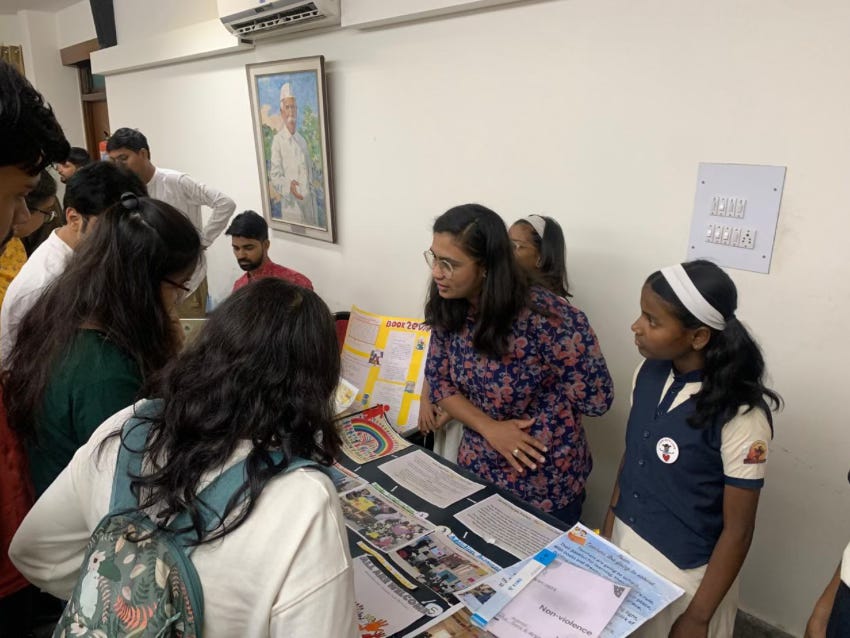
I realised that I wanted to work in the social sector, especially on women’s issues. I was selected by the Indian School of Development Management for their course on women- and family-centred practices. I also cleared the NET after preparing for three to four months. After discussions, I chose the Teach for India Fellowship.
Y: How was your experience in this period?
P: I worked in Gadchiroli, in a tribal area where women are forced to live outside their homes during menstruation. Many women died due to snake bites. During the COVID pandemic, I helped arrange plasma donors for patients. I also began reading thinkers such as Dr. B.R. Ambedkar, Bhagat Singh, Savitribai Phule, and Mahatma Phule. This shaped my understanding of caste, gender, and justice.
My father died by suicide due to debt; he was a farmer. My joining date for Teach for India was only eight days after his death, so I had to request an extension. The fellowship stipend helped me survive and support my siblings, which I continue to do even today. I also managed to fund my sister’s education at Fergusson College.
Y: I’m sorry to hear about your father. It is inspiring how you became your family’s pillar of support through it all. You mentioned that you joined TFI thereafter; how was your experience there?
P: Teach for India is an elite fellowship, and many fellows come from privileged institutions. English suddenly became a major barrier for me, even though I had always been confident in my language skills. I had to teach in an English-medium school, but I began to hesitate to speak in English myself because I started doubting my abilities.
People talk about inclusivity but often practise judgment. There is a gap between what is discussed in air-conditioned rooms and what is actually practised on the ground.
Y: Would you like to share how caste affected your life?
P: I belong to a so-called higher caste, but in practice, being a girl from a farming background meant facing discrimination. I played football, rugby, and cricket, and I am a national-level wrestler. I faced differential treatment in sports. In fact, someone more privileged than I was paid money and replaced me in a football national tournament. That same team later played internationally.
I missed many opportunities due to money, caste, and gender. Even buying sports shoes was difficult.
Y: What does work look like for you currently?
P: I completed my Teach for India Fellowship in 2025 and then started working as a teacher trainer in a Pune-based NGO. Soon after, I was selected for the Chief Minister’s Fellowship, and I now work in Satara with the District Collector. Alongside this, I am pursuing a postgraduate certification in public policy from IIT Bombay as part of my fellowship.
Y: What is something you never thought you could do in your journey but did?
P: I never imagined losing a parent and joining a fellowship within ten days. I never thought I would work with elite institutions or study at IIT Bombay. I never thought I would become financially independent, fund my siblings’ education, or take my own decisions as a woman from my background.
Y: What advice would you give to other first-generation students like yourself?
P: Your struggle will pay off. Prioritise your education and your ambitions. Do not quit due to financial difficulties; scholarships exist. If you are ready to fight, the world will support you.
Y: Thank you so much, Pratiksha.
P: Thank you!
This is an ongoing series of profiles documenting the experiences of young people across India. Stay tuned for more stories from first-generation students across India. Follow us on social media for more updates.