
The Pehli Peedi Fellowship presents the first in a series of stories highlighting the experiences of first-generation students across India.
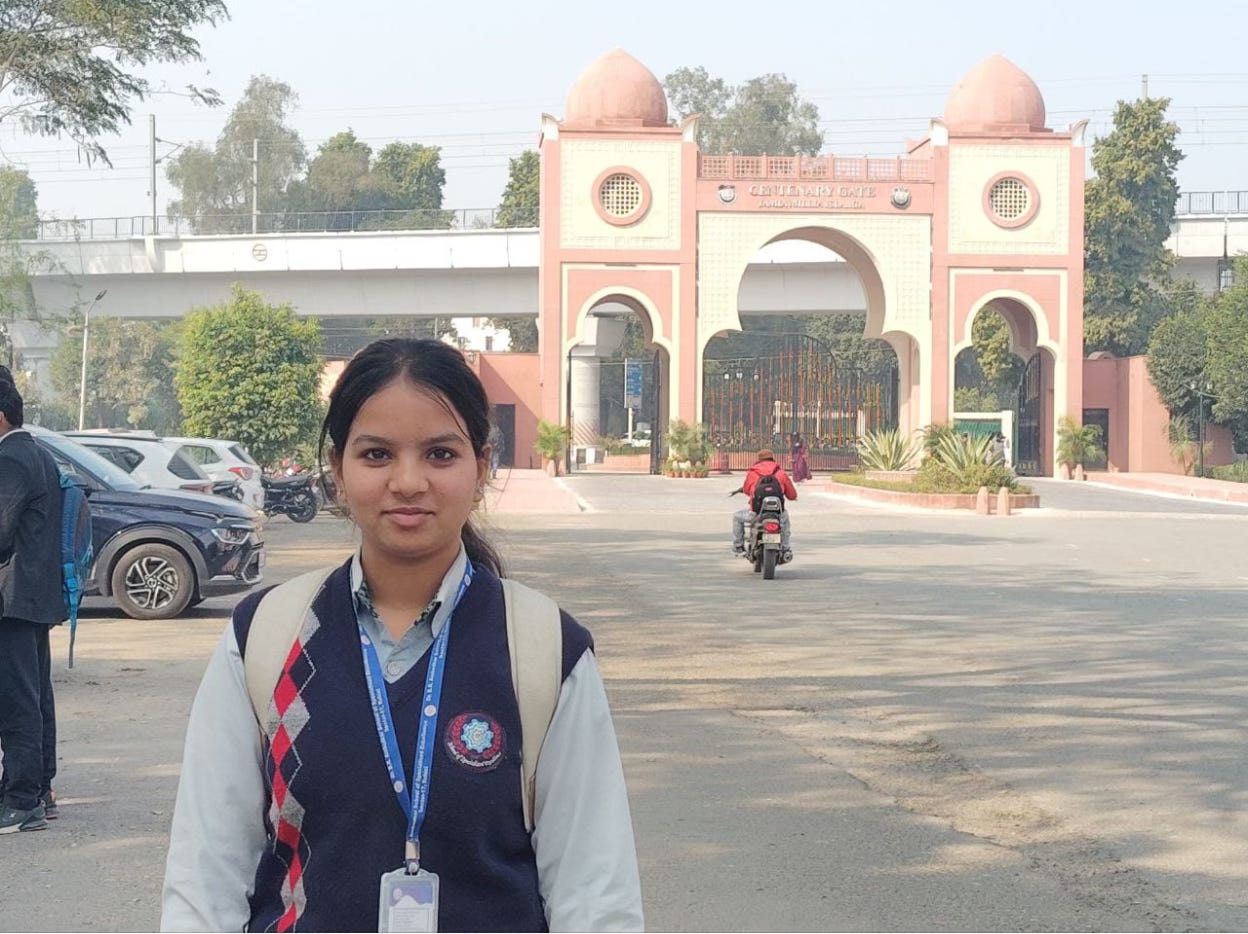
At just 18, Manshi Singh is navigating multiple worlds at once — distance-learning at the University of Delhi, preparation for competitive government examinations, and a quiet but determined pursuit of journalism and art. Raised in a family where financial stability comes before passion, Manshi’s journey reflects resilience, discipline, and an unwavering belief in creative expression. Through words, drawings, and self-made projects, she continues to shape her own future.
“There is no point in living in the regret of not being able to become a journalist; I choose to do what I can towards that dream instead.”
Read his full story below. Profile by Yatika Singh.
Yatika: Hi Manshi! Could you tell me about yourself?
Manshi: Hello! My name is Manshi Singh, and I’m from Delhi. I am currently a first-year student in the distance-learning Bachelor of Arts programme at the University of Delhi. At the same time, I am also preparing for entrance examinations for government jobs.
Y: Which government jobs are you applying for?
M: I’m currently preparing for jobs at the Delhi Development Authority that are open to high school graduates. In particular, I’m trying for a Junior Secretariat Assistant position. Ultimately, I want to apply for jobs in the Ministry of External Affairs.
Y: Besides your parents, who is in your family? What is their educational background and what do they do?
M: My family comprises my parents, my elder brother, and me. My father is a small business owner. He repairs RO water purifiers and power inverters. My mother is a homemaker. My elder brother is a college graduate who is now preparing for government job examinations. Neither of my parents has a college degree. While my mother has completed her primary education up to grade five, my father does not have any formal qualifications. However, he has a knack for languages and knows many, including English and Hindi.
Y: Did you study in a public or private school before joining university?
M: I studied in public schools throughout my education. In grade 9, I was admitted to a Dr. B. R. Ambedkar School of Specialised Excellence (SOSE). Many of these schools were started by the then Government of Delhi and focus on teaching the humanities. I was selected, and it felt like a big opportunity. Since most of my education before that was in Hindi-medium schools, I noticed a significant difference in English proficiency between public and private school students.
Y: Has English been a hurdle for you in your journey?
M: I never felt fully comfortable with my English, especially when private school students spoke fluently during inter-school events and competitions. This was one of the main reasons I applied to SOSE — it was English-medium, and I wanted to improve my language skills. Even there, I faced difficulties because private school students were often more fluent. Many of us did not get the chance to present ourselves, as preferential treatment was given to those fluent in English when interacting with important guests at events. Now, I am trying to improve my speaking skills with the help of my brother and a friend from school. Even this interview is an effort to build my confidence in English. I keep trying.
Y: What subjects did you choose at SOSE?
M: I want to become a journalist, but my parents do not fully understand the scope of this career. I chose Mass Media as an elective subject in grade 12, and it felt like a chance to prove myself to them. I scored 97 out of 100. Still, they did not agree to let me take journalism as my college major. After that, I decided to prepare for government job examinations and enrolled in a distance-learning course. The subjects I had taken in high school also proved useful in my exam preparation.
Y: How has financing your university education been for you?
M: There have been many difficulties. My father is the sole earner in our family and runs a small business. This year, he underwent three surgeries related to diabetes, and it has been difficult for him even to walk. I had cleared CUET for Journalism with good marks, but I could not register in time because we did not have the funds at that moment. Later, after the registration deadline, I received a 100% scholarship along with a free laptop. If we had the money at that time, I could have been pursuing my dream today. To fund my current course, I worked a freshers’ job at Amazon for three months. I saved ₹25,000 from my first salary and paid my college fees.
Y: Do you have any mentors in your life who inspire you?
M: Yes, my neighbour Komal di, who works at the DDA, inspired me to apply there as well. She gave me her old study material and consistently advised me on the best way to prepare for government jobs. She often shares newly released government job forms with me. Her brother, who is a Superintendent in GST and Customs, also helps and guides me in my journey.
Y: Were there any hurdles in your transition from school to college?
M: Art has always been my hobby. I planned to continue drawing alongside my university studies, and I still do, but my mother often tells me that nothing will come out of my artwork. She believes that only studying will help you get a job. I, however, believe that many skills are required to build a career. I tried to convince my parents by sharing research about how art helps reduce stress in students. Convincing them to let me continue art as a hobby was my biggest challenge. Academics have not been a major issue, because my professors are very helpful and provide extra material if we show interest.
Y: Have you been able to continue with your art hobby?
M: Yes, I now make hampers, gift baskets, portraits, and other customised gifts. I post my artwork on Instagram and earn a little from it, which I use to buy my own art supplies since my parents do not agree to spend money on them. I am also doing a fellowship with a media house where I write articles every two weeks. At the same time, I am working on my YouTube channel, where I post art and craft content as well as independent journalistic projects. So far, I have made videos about my artistic journey and about poetry. I also have podcasts on films and reflections on life. One of my projects, titled Kiran, documents the journeys of first-generation students like me. These interactions have taught me a lot. Even if my parents are not fully supportive of my passion, I do not want to stop myself from pursuing it.
Y: What does success mean to you right now?
M: For me, success means satisfying my parents. I want to hear them say, “Now you can do anything that you want.” In high school, I decided that I would pursue journalism with my own money after getting a government job, because that is the only definition of success they understand. I do not want to give my parents the chance to say that I wasted their money. My sole focus has always been journalism. I believe I was born for it. There is no age for studying — I can always earn a degree after I start working.
This is an ongoing series of profiles documenting the experiences of young people across India. Stay tuned for more stories from first-generation students across India. Follow us on social media for more updates.