
The Pehli Peedi Fellowship presents the first in a series of stories highlighting the experiences of first-generation students across India.
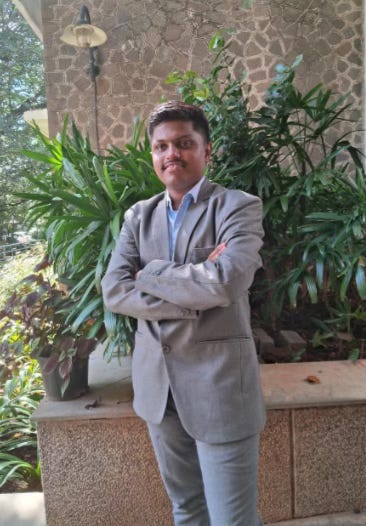
Balaji Rajmane, from Maharashtra’s Adas village, rose from deep poverty to become a first-generation university student. His father once sold a gold Rakhi just to buy him textbooks. Battling an intense sense of inferiority at Fergusson College, he gradually rebuilt his confidence through debates, social work, and leadership initiatives. Today, he is pursuing a Master’s in Financial Economics on a VSM scholarship—still facing academic gaps but persevering with determination. His dream: to achieve financial stability and eventually build an NGO to support underprivileged students across India.
“When you come from a background like mine, confidence is something you build—not something you inherit.”
Read his full story below. Profile by Bhumeshwari.
Bhumeshwari: Tell us about your background and family.
Balaji: I’m from Adas village in Beed district, Maharashtra. My family includes my parents, grandfather, and younger brother. Both my parents are daily wage labourers and we own very small pieces of land. My father failed 10th grade three times because he had to work to support the family, and my mother never went to school. There’s no educational history at home, but my family firmly believes that education is our path out of poverty.
Bhumeshwari: Who inspired you to go to college?
Balaji: Teachers like Manik Maske Sir and Dattaprasad Goswami Sir guided me immensely. In high school, Maske Sir taught me English grammar, and thanks to him I scored well in the 10th exam. Later, Goswami Sir encouraged me to participate in extracurriculars and read more, which shaped my growth.
Bhumeshwari: How did you get to college?
Balaji: After 10th, I wanted to pursue science or medicine, but poverty was a huge barrier—my family couldn’t afford the 11th-grade NCERT books. My aunt gave my father a gold Rakhi, and he sold it to buy the books. Seeing their struggle, I switched to commerce and developed an interest in UPSC. I excelled in debates and won prizes at the sub-district level. Inspired by Ansar Sheikh—the youngest IAS officer from Maharashtra and a Fergusson alumnus—I set my sights on Fergusson College. Getting in was a proud moment, especially since someone willing to pay lakhs couldn’t get admission.
Bhumeshwari: What hurdles did you face entering college?
Balaji: The ₹8,000 fee was a huge challenge—we had to borrow it from relatives. At Fergusson, I initially focused on extracurriculars, but later took a part-time job as a Monitoring & Evaluation Officer for five months to support myself. Balancing work and academics was tough and affected my grades.
Bhumeshwari: What was your college experience like?
Balaji: I struggled with a deep inferiority complex. Coming from a village, I lacked dressing sense, English fluency, and confidence in presenting what I knew. I constantly compared myself to others. But Fergusson’s strong extracurricular culture helped me rebuild myself—it boosted my confidence. Many students from rural backgrounds face this same struggle.
Bhumeshwari: And university life now?
Balaji: I’m pursuing a Master’s in Financial Economics at Gokhale Institute, Pune. The competition initially shattered my confidence. My foundational knowledge feels weaker compared to students from places like Delhi. Even adjusting to professors’ diverse accents takes time.
Bhumeshwari: How do you manage academic stress?
Balaji: The library gives me a sense of belonging. I rely on tutors, friends, and especially teaching assistants. They often explain concepts in Marathi and suggest reference books that help me stay on track.
Bhumeshwari: What are your goals?
Balaji: In the short term, financial stability and a job are my priorities. In the long term, I want to return to my community and support students like me. I hope to build an NGO focused on skill empowerment across India. For now, success means getting placed—financial security is essential.
Bhumeshwari: How are you financing your education?
Balaji: Vidyadaan Sahayyak Mandal (VSM) supports me by covering accommodation and food through a scholarship, and my education fees through a zero-interest loan after a thorough interview and screening process. VSM also provides mentorship. My mentor, Pallavi Mulay Maushi, is incredibly supportive and always guides me.
Bhumeshwari: As a first-gen student, how do people perceive you?
Balaji: In our community, where no one is educated, people offer advice without understanding our circumstances. But when someone becomes educated, they can guide the family forward. I’ve also felt bias based on language, though never directly confronted.
Bhumeshwari: What should universities understand about students like you?
Balaji: Universities must treat all students equally—no preferential treatment and no neglect. Teachers should actively support weaker students so they can reach the same level as others.
Bhumeshwari: What have you learned about yourself?
Balaji: I’ve developed critical thinking, emotional balance, and decision-making skills. Being the older brother also means I carry significant family responsibilities.
Bhumeshwari: Advice for other first-gen students?
Balaji: Don’t hesitate to seek guidance. When you face setbacks, keep trying—persistence solves problems. Maintain continuity and consistency. Choose your friends wisely; even one or two trustworthy friends make a big difference. And avoid distractions like drinking, smoking, or drugs. Stay focused.
Bhumeshwari: What would you change in higher education?
Balaji: Fees should be minimal so education is accessible. Colleges need qualified teachers—those lacking knowledge should undergo 15–30 days of training. Better software and infrastructure are essential. Teachers must address students’ questions instead of ignoring them.
Bhumeshwari: What achievement surprised you?
Balaji: My involvement in extracurriculars and community service! I did NSS camps for two years. I worked with the Relief Foundation for five months and with Shikshanganga Foundation for 2–3 years conducting science workshops. I taught science, English, and maths at a virtual learning centre for students from grades 7–10.
I also connected with the Dyanprabodhini organization and secured a scholarship by ranking second in their social leadership development program after clearing an exam and interview. I initiated the National Integrity Tour (NIT), taking over 55 volunteers to Meghalaya, Assam, Pondicherry, and Kerala to collaborate with villages and foundations. These experiences transformed me.
This is an ongoing series of profiles documenting the experiences of young people across India. Stay tuned for more stories from first-generation students across India. Follow us on social media for more updates.
Balaji's story really shows how finanical barriers shape confidence for first gen students. The fact that his father sold a gold Rakhi just for textboks is powerful. These stories need more visibility.
Great initiative. I can relate to some of the experiences as pehli peedi graduate myself!